







Sizable Energy is reimagining century-old pumped hydro—at sea—to deliver scalable, low-cost energy storage for a renewable-powered world.
Rethinking an Old Idea for a New Energy Era
When Manuele Aufiero first saw pumped-storage hydropower as a child in northern Italy, he was mesmerized. Now, decades later, he’s leading a startup that’s taking that century-old energy storage concept to the ocean floor.
His company, Sizable Energy, has raised $8 million to scale a new kind of undersea energy storage system, potentially solving a growing global problem: how to store renewable energy at scale, cheaply, and reliably.
“I’m in love with pumped hydro,” Aufiero told TechCrunch. “It’s just not enough to keep up with renewables.”
The Problem with Traditional Pumped Hydro
Pumped hydro is currently the largest form of grid-scale energy storage on Earth, storing 8,500 GWh globally. It works by moving water between two reservoirs at different elevations—pumping it up when electricity is cheap, and letting it flow down to generate power when demand spikes.
The catch? It requires very specific topography, and concrete-heavy infrastructure, making it expensive, slow, and site-limited.
Sizable Energy’s Seafloor Solution
Sizable’s idea is deceptively simple: use gravity underwater. Their system works like this:
- Two flexible, sealed saltwater reservoirs: one floating, one anchored to the seabed.
- A plastic pipe connects them, containing turbines.
- When energy is plentiful, high-salinity water is pumped up to the floating reservoir.
- When energy is needed, gravity pulls the denser saltwater down, spinning turbines to generate power.
“From the energy balance point of view, we are just lifting a heavy amount of salt,” Aufiero said.
By using dissolved salt instead of solid mass, Sizable avoids mechanical complexity and can build everything modularly and identically, regardless of geography.
Why the Ocean?
The key to Sizable’s approach is that the ocean provides the elevation difference—no mountain or valley required. This allows:
- Mass production of modular systems
- Rapid deployment in any deep water (500+ meters)
- Integration with offshore wind farms for shared grid connections
Because every site shares the same basic underwater mechanics, there’s no need to custom-build dams or adapt to local terrain—unlocking massive scalability.
What’s Next?
Sizable has already:
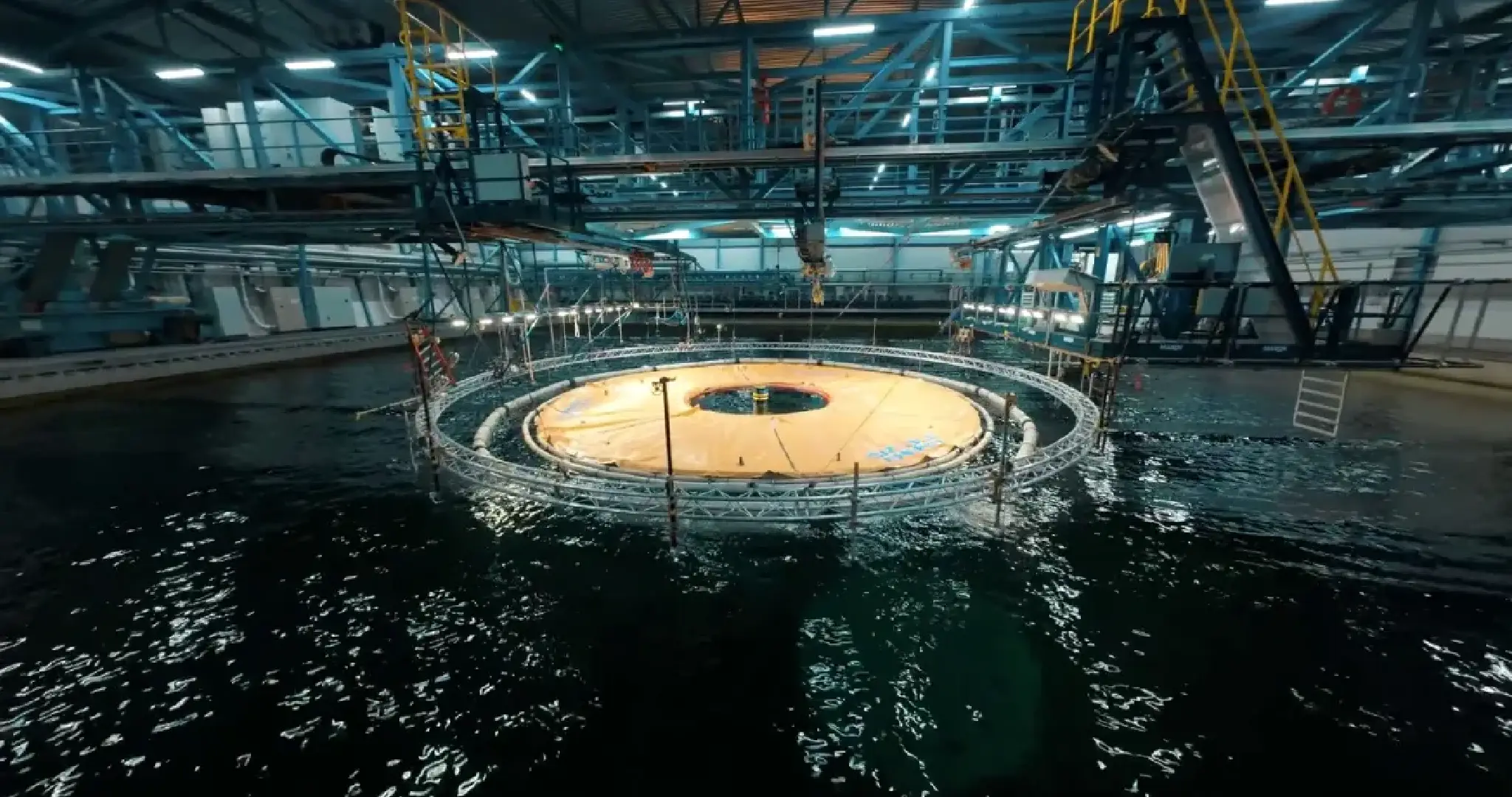
- Tested small-scale systems in wave tanks
- Conducted field trials near Reggio Calabria, Italy
- Begun deployment of a floating pilot system
- Set its sights on full-scale demo plants by 2026
The company says each turbine will generate 6–7 megawatts, and systems can be scaled by adding more turbines and longer pipes. In deeper waters, energy storage potential increases.
Goal: Deliver energy storage at €20/kWh (~$23) — nearly 10x cheaper than today’s grid-scale lithium-ion batteries.
Built for the Energy Transition
Sizable’s approach isn’t just novel—it’s urgently needed. With intermittent sources like wind and solar dominating new generation, long-duration energy storage is no longer optional. Batteries alone won’t be enough.
“There is no way we can keep up with that with traditional pumped hydro or batteries,” Aufiero said. “We need something new.”
And unlike controversial solutions like hydrogen or carbon capture, Sizable’s underwater pumped storage is passive, non-combustive, and grid-ready.