








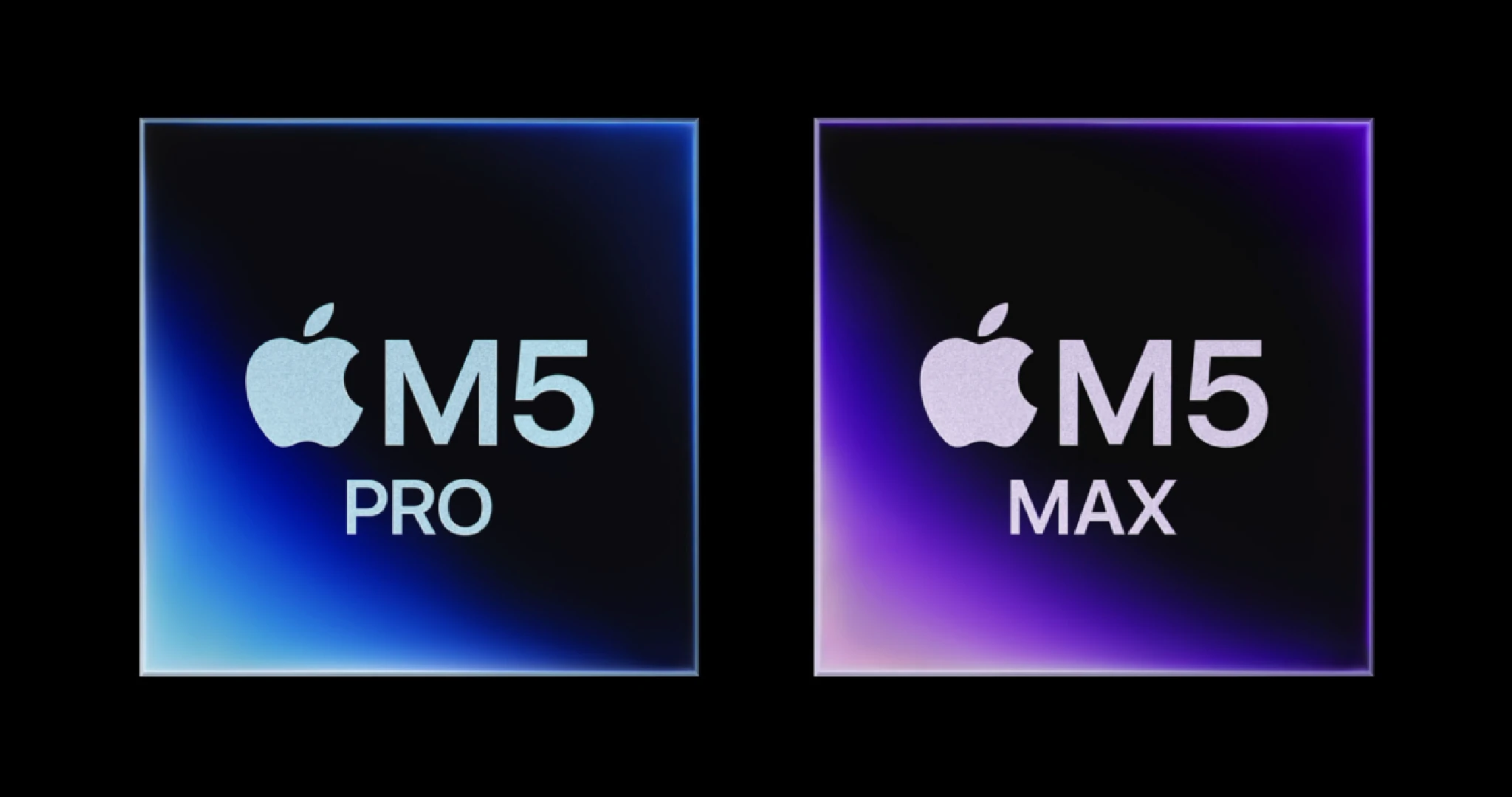
New chips bring 18-core CPUs, up to 40-core GPUs, and major AI compute gains for developers, creators, and researchers
Apple has unveiled its latest M-series silicon, introducing the M5 Pro and M5 Max chips designed to power the newest MacBook Pro lineup.
The headline feature is Apple’s new Fusion Architecture, which combines two chip dies into a single high-performance system-on-a-chip (SoC). The design integrates CPU, GPU, Media Engine, Neural Engine, unified memory controller, and Thunderbolt 5 support.
The goal: deliver significantly higher compute power while maintaining Apple’s tightly integrated silicon ecosystem.
A New Architecture at the Core
At the center of the upgrade is Apple’s Fusion Architecture, which merges multiple chip components into one unified design.
The architecture integrates:
- CPU and scalable GPU
- Media Engine
- Unified memory controller
- Neural Engine
- Thunderbolt 5 connectivity
By merging two dies into a single SoC, Apple aims to deliver higher performance and improved efficiency for demanding workloads.
18-Core CPU: A Major Upgrade
Both the M5 Pro and M5 Max feature an 18-core CPU, a step up from earlier generations.
Previous models included:
- M4 Pro: 14-core CPU
- M4 Max: 16-core CPU
The new chip layout includes:
- 6 “super cores” for maximum performance
- 12 newly designed performance cores
Apple says the upgraded CPU delivers up to 30% faster performance for professional workloads.
This boost targets tasks like software compilation, data modeling, and complex simulations.
GPU Built for AI and Graphics
Graphics processing sees another major upgrade.
The chips feature up to a 40-core GPU, scaling the architecture first introduced in the base M5 chip.
Apple says the GPU delivers:
- Up to 20% faster overall graphics performance
- Up to 35% faster ray-tracing workloads
Each GPU core now includes a Neural Accelerator, enabling stronger AI and machine-learning compute capabilities.
According to Apple, the architecture provides more than 4× the peak GPU compute for AI compared to the previous generation.
For developers and researchers working on AI models or GPU-heavy applications, this is a significant leap.
Bigger Memory and Faster Bandwidth
Apple also expanded the chips’ unified memory capacity and bandwidth, key metrics for professional workloads.
M5 Pro
- Up to 64GB unified memory (previously 48GB)
- 307GB/s memory bandwidth
M5 Max
- Up to 128GB unified memory
- 614GB/s memory bandwidth
Unified memory allows CPU, GPU, and AI engines to access the same data pool, which reduces bottlenecks in large data processing and graphics workflows.
Who These Chips Are For
Apple positions the chips for different categories of professional users.
M5 Pro targets:
- Data modelers
- Post-production audio engineers
- STEM students and researchers
M5 Max targets:
- 3D animators
- App developers
- AI researchers running GPU-heavy workloads
In short, the M5 Pro prioritizes balanced compute, while the M5 Max focuses on maximum GPU power and memory bandwidth.
New MacBook Pro Launch Timeline
The M5 Pro and M5 Max will power Apple’s latest MacBook Pro models.
Key dates:
- Preorders: begin tomorrow
- Availability: March 11
With stronger AI compute, faster GPUs, and expanded memory capacity, Apple is positioning the new chips as the next step in high-performance laptop silicon.
But as AI workloads grow and developer tools evolve, the real test will be whether Apple’s custom silicon can continue outpacing rivals in the AI era.
TL;DR:
Apple unveiled M5 Pro and M5 Max chips with a new Fusion Architecture, combining two dies into a single SoC. The chips feature 18-core CPUs, up to 40-core GPUs, faster ray tracing, and up to 128GB unified memory, delivering major gains for AI, graphics, and professional workloads.
AI summary
- Apple launches M5 Pro and M5 Max chips for MacBook Pro
- New Fusion Architecture merges two dies into one SoC
- 18-core CPU delivers up to 30% performance boost
- GPU scales to 40 cores with 4× AI compute
- MacBook Pro models launch March 11